IPTV (Internet Protocol Television) delivers live television and on-demand video over an IP network instead of traditional terrestrial, satellite, or cable broadcast signals. Rather than pushing a signal to everyone within range, IPTV sends video packets directly to your device over the same TCP/IP protocol family that powers web browsing, email, and VoIP.
In practice, that means you can watch live channels, rewind broadcast programming, and pull from a vast on-demand library through a single application on your smart TV, phone, set-top box, or computer. The only hard requirement is a stable broadband connection with sufficient throughput — no antenna, dish, or coaxial wall outlet required.
Executive Summary: Iptv
Best For
Cord-cutters and international viewers who want live sports, global channels, and VOD across multiple devices without a cable contract.
Standout Feature
Unicast delivery over managed IP infrastructure with near-zero latency for live events.
- ✓ IPTV uses unicast streaming, sending content directly to your device only when requested — not broadcasting to everyone in range.
- ✓ Requires 25+ Mbps for stable HD and 50+ Mbps for buffer-free 4K playback on most premium services.
- ✓ Top-tier IPTV providers deliver 20,000+ live channels and 40,000+ VOD titles at roughly one-tenth the cost of cable.
Quick Navigation
What Is IPTV and How Does It Work?
To understand how IPTV works, you first have to set aside the broadcast model. Traditional television uses one-to-many transmission: a broadcaster sends a signal into the air or through a cable plant, and any receiver tuned to that frequency captures it. IPTV inverts that model. It uses one-to-one unicast streaming, where the server sends a dedicated stream of IP packets to your device only after you request it.
When you select a channel on an IPTV app, your device sends an Internet Group Management Protocol (IGMP) join request to the service's middleware server. That server authenticates your subscription, checks available bandwidth, and instructs the content delivery network (CDN) to begin pushing the requested stream. The stream arrives as a sequence of compressed video frames — typically H.264 or H.265/HEVC — wrapped in RTP (Real-time Transport Protocol) or HLS (HTTP Live Streaming) segments. Your device decodes those frames in real time and renders them to your screen.
The entire round-trip, from channel selection to first frame displayed, typically takes between 1 and 3 seconds on a well-configured service. That is the core IPTV user experience: a live, interactive, on-demand television session delivered entirely over internet infrastructure.
How Does IPTV Work in Practice?
A premium IPTV subscription gives you instant access to 20,000+ live channels, 40,000+ VOD titles, and 4K sports streams — all delivered through the exact IP infrastructure described above.
What's Included:
- ✓ 20,000+ live channels across sports, news, entertainment, and international networks
- ✓ 40,000+ movies and series in 4K, FHD, and HD with adaptive bitrate streaming
- ✓ 99.9% uptime guarantee with anti-freeze technology and 24/7 support
Guaranteed authentic checkout directly from the manufacturer.
Core Mechanics: Protocols, Streaming, and Delivery
Related Reading: Free TikTok Followers: 2026 Verified Guide That Works
Three architectural layers make IPTV work, and understanding them answers the question "how does IPTV work" at a deeper level than any surface explanation.
1. The Headend. This is where content is acquired, transcoded, and packaged. Live channels are captured from satellite feeds or terrestrial sources, transcoded into efficient video codecs, and encrypted with DRM. On-demand titles are stored on massive media servers and prepared in multiple bitrate renditions for adaptive streaming.
2. The Middleware. Middleware is the control plane. It manages subscriber authentication, electronic program guides (EPG), channel authorization, and billing. When you open the IPTV app, middleware validates your credentials and builds the channel list you see. It also handles VOD catalog organization and search.
3. The Delivery Network. IPTV services rely on CDNs and edge servers to minimize latency. Content is cached at geographically distributed points of presence (PoPs) so that video travels the shortest possible path to your device. Adaptive bitrate streaming (ABR) continuously monitors your connection and adjusts quality on the fly, dropping from 4K to 1080p or 720p to prevent buffering.
Protocols matter. Most commercial IPTV services use one or more of the following:
- IGMP — Used for live multicast streams, allowing one upstream feed to fan out to many viewers efficiently.
- RTP/RTSP — Real-time transport protocols for low-latency live streaming.
- HLS (HTTP Live Streaming) — Apple's adaptive streaming standard, used for VOD and catch-up TV.
- MPEG-DASH — The ISO-standard adaptive streaming alternative to HLS.
A critical distinction: true IPTV operates on a managed network with guaranteed quality of service (QoS). Over-the-top (OTT) services like Netflix run over the open internet with no such guarantees. That is why premium IPTV providers can deliver live sports with sub-second latency while OTT platforms often lag 30–60 seconds behind the live event.
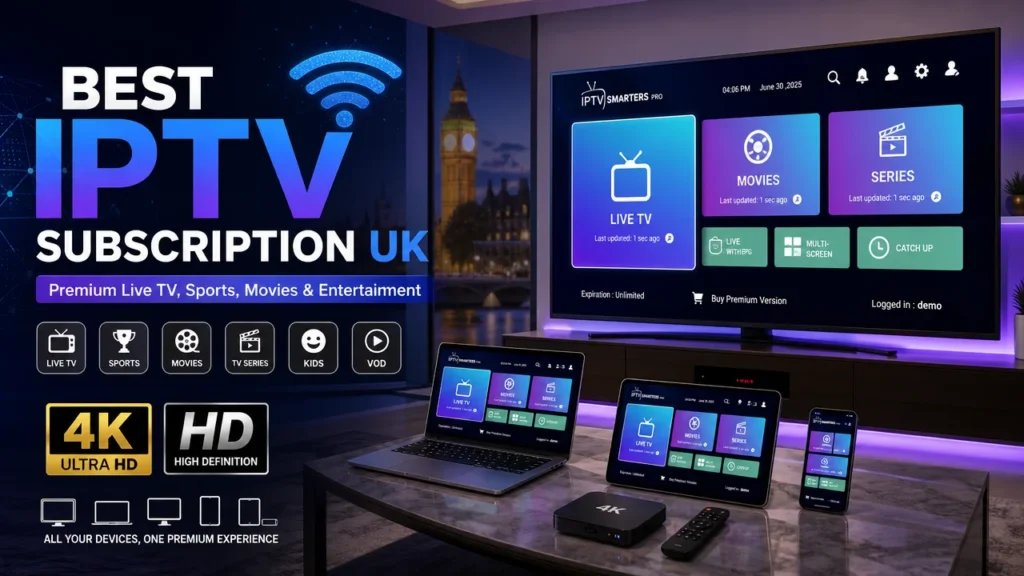
IPTV vs Cable vs Streaming: Comparison Matrix
To evaluate IPTV fairly, it helps to place it side by side with its two primary alternatives: traditional cable and OTT streaming platforms. The table below breaks down the key differentiators across delivery, content, and cost.
| Criteria | IPTV | Cable TV | Streaming (OTT) |
|---|---|---|---|
| Delivery Method | Managed IP network, unicast/multicast streaming | Coaxial RF broadcast | Open internet (OTT) |
| Infrastructure Required | Broadband internet + app or set-top box | Coaxial cable plant + set-top box | Broadband internet + smart device |
| Channel Lineup | 10,000–25,000+ channels | 200–600 channels | 50–200 live channels per service |
| On-Demand Library | 40,000+ titles with catch-up TV | Limited, provider-controlled | 20,000+ titles per platform |
| Live Event Latency | 1–3 seconds | 0–1 second | 30–60 seconds |
| Equipment Cost | $0–$50 (app or box) | $50–$200 (rental fees) | $0–$70 (device) |
| Monthly Cost | $10–$20 | $60–$150 | $15–$80 |
| Best For | Cord-cutters, international viewers, sports fans | Traditional households, rural areas | Mainstream audiences, original content |
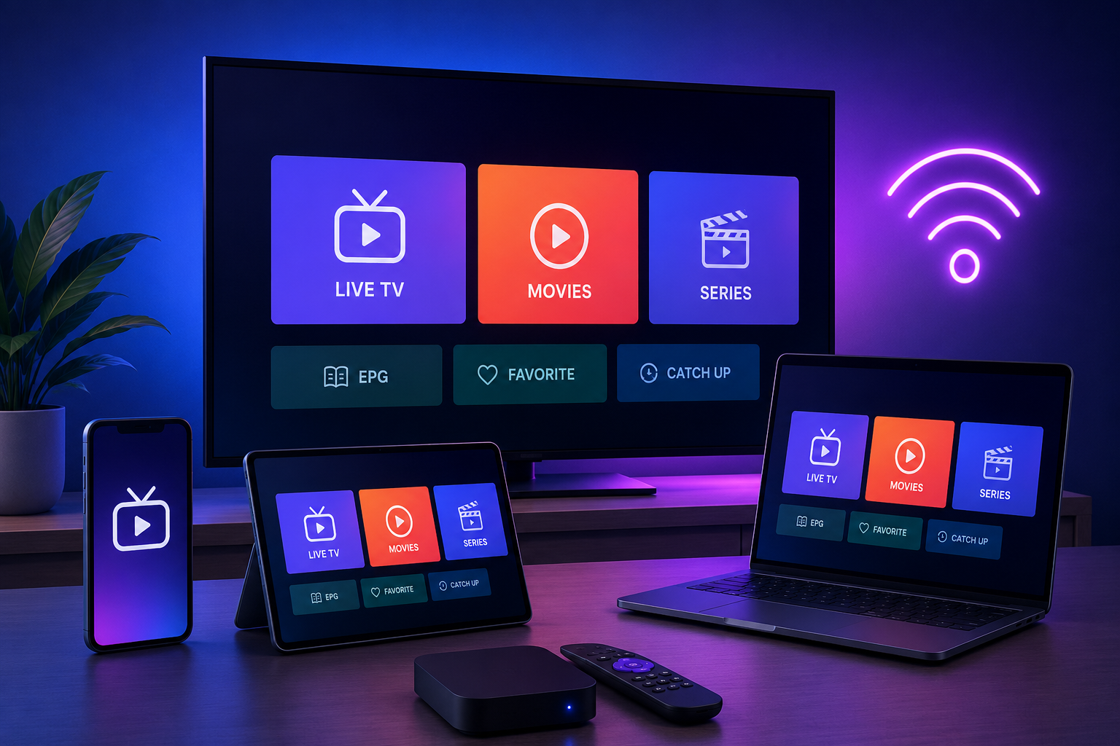
Pros and Cons of IPTV
Related Reading: Tvpassorg Review 2026: Is This IPTV Deal Worth It?
No evaluation is complete without a balanced look at trade-offs. Here is an objective breakdown of what IPTV does exceptionally well and where it falls short.
Pros:
- Cost efficiency: Premium IPTV subscriptions run $10–$20/month versus $60–$150 for cable with comparable channel depth.
- Channel depth: 20,000+ channels including international, niche, and premium sports packages that cable cannot match.
- Device flexibility: Watch on Android, iOS, Smart TV, Firestick, MAG boxes, PCs, and more — often simultaneously.
- VOD integration: Catch-up TV and 40,000+ on-demand titles in one interface, eliminating the need for separate streaming subscriptions.
- No long-term contract: Most providers offer monthly plans with no commitment, unlike 12–24 month cable agreements.
Cons:
- Internet dependency: A sub-25 Mbps connection produces buffering and quality drops. IPTV is only as good as your broadband.
- Legal gray area: Some IPTV services carry unlicensed content. Always verify provider legitimacy before subscribing.
- Setup complexity: Requires configuring apps, EPG, or external players on some devices. Not as plug-and-play as cable.
- VPN compatibility: Some providers block known VPN IP ranges, which can complicate privacy setups.
Cost-Benefit Analysis and Ideal Buyer Profile
Let's quantify the decision. A standard cable bundle with 200 channels, a DVR, and premium movie channels costs roughly $120/month. A premium IPTV subscription with 20,000 channels, 40,000 VOD titles, and pay-per-view sports costs $15/month. Over 12 months, that is a difference of $1,260. Even after adding a high-speed internet plan — which most households already have — IPTV saves the average cord-cutter $800–$1,000 per year.
Beyond raw cost, the value equation includes content access. Cable cannot deliver 20,000 channels because its RF spectrum is physically limited. OTT platforms like Netflix and Hulu offer deep original libraries but shallow live TV. IPTV sits in the intersection: live television with broadcast-grade latency plus a VOD library that rivals dedicated streaming services.
The ideal IPTV buyer:
- Watches live sports or international channels not available on local cable.
- Wants one subscription across multiple devices — TV, phone, tablet, and laptop.
- Is comfortable configuring apps and troubleshooting streaming settings.
- Has broadband internet of at least 50 Mbps.
- Wants to avoid annual cable contracts and equipment rental fees.
If that description matches you, IPTV delivers the highest content-per-dollar ratio in television today.
Our Clear Verdict on Iptv
IPTV is not a gimmick — it is a fundamental shift in television distribution, and for the right user it outperforms cable and mainstream streaming in channel depth, cost, and flexibility. If you have reliable broadband and want 20,000+ channels plus VOD for under $20/month, IPTV is the clear winner and the highest-ROI television purchase you can make in 2026.
Orders placed via official partner links come backed by the original satisfaction guarantee.
Frequently Asked Questions
Related Reading: IPTV Abonnement Review 2026: Ratings, Pricing & Top Pick
Is IPTV legal?
IPTV technology itself is completely legal — it is simply a method of delivering video over IP networks. Legitimate IPTV services hold broadcasting rights and licensing agreements for the content they distribute. However, some unlicensed providers sell access to streams without proper rights, which is illegal in most jurisdictions. To stay safe, choose a provider with transparent licensing, verified uptime, and a physical business presence.
What internet speed do I need for IPTV?
For standard definition, 10 Mbps is sufficient. For HD (1080p) streaming, you need at least 25 Mbps. For 4K UHD content, 50 Mbps or higher is recommended to avoid buffering and quality drops. Keep in mind that these figures assume the connection is dedicated to streaming; if other devices share your bandwidth, add 10–15 Mbps as a buffer. A wired Ethernet connection will always outperform Wi-Fi for IPTV stability.
What equipment do I need to watch IPTV?
Most modern IPTV services work on devices you already own: smart TVs (Samsung, LG, Sony), Android and iOS phones, tablets, Amazon Firestick, Apple TV, and PCs. Some users prefer dedicated IPTV set-top boxes like MAG or BuzzTV for a more traditional TV experience. You do not need a satellite dish, antenna, or coaxial cable — just an internet connection and the provider's app or playlist URL.
Can I use IPTV on multiple devices at the same time?
Yes, most premium IPTV providers allow concurrent connections. Entry-level plans typically support 1–2 simultaneous streams, while family plans support 3–5 or more. If you plan to watch on your living room TV while someone else streams on a phone or tablet, verify the provider's multi-device policy before subscribing. Some also offer a "1 connection, unlimited devices" model where only one stream is active at a time.
What is the difference between IPTV and Netflix?
Netflix is an over-the-top (OTT) service that delivers exclusively on-demand content over the open internet. IPTV delivers both live television and on-demand content over a managed IP network with quality-of-service guarantees. That distinction matters: IPTV can carry live sports, news broadcasts, and international channels with 1–3 second latency, while Netflix and similar OTT platforms cannot provide live linear TV at broadcast-grade quality. IPTV is closer to a cable replacement; Netflix is a VOD supplement.
Does IPTV work with a VPN?
Most IPTV services work with VPNs, and using one can protect your privacy from ISP throttling. However, some providers block known VPN IP ranges to comply with content licensing restrictions. If you plan to use a VPN, choose a provider with obfuscated servers or confirm with the IPTV service that their infrastructure permits VPN traffic. For live sports, a VPN can also help bypass regional blackout restrictions, though this may violate terms of service.
Can IPTV replace cable for live sports?
Yes — and for many viewers, it does so at a fraction of the cost. Premium IPTV services carry major sports networks including ESPN, beIN Sports, Sky Sports, DAZN, and regional sports channels, often in 4K with sub-second latency. The key advantage is that IPTV delivers live events with only 1–3 seconds of delay, compared to 30–60 seconds on OTT platforms, making it viable for real-time viewing and betting. Always confirm that your chosen provider carries the specific leagues and channels you follow.
How do I choose a reliable IPTV provider?
Look for four things: uptime guarantee (99.9% or higher), responsive 24/7 customer support, a free trial or short-term plan to test quality, and transparent licensing. Read independent reviews on forums like Reddit and Trustpilot to verify real-world performance. Avoid providers that require annual prepayment upfront or that refuse to disclose their server infrastructure. A reliable provider will offer multiple payment methods, clear refund policies, and consistent stream quality during peak evening hours.
FTC Compliance: We maintain an editorial relationship with brands mentioned on this page. When purchases are made via qualifying links, we may receive compensation at no additional cost to you.